
a2z.sanbrains-agency.in

```html
PRECISION ENGINEERING

Four-Row Cylindrical Roller Bearings

Four-row cylindrical roller bearings are high-capacity rolling-element bearings designed to support very heavy radial loads while maintaining high rigidity and reliable performance. Their multi-row roller arrangement makes them particularly suitable for demanding industrial applications where high load capacity and compact bearing arrangements are required.
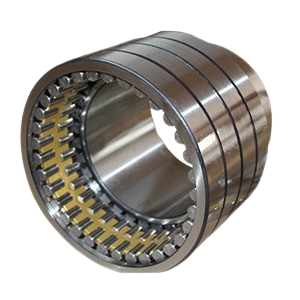
Four-Row Cylindrical Roller Bearing
01 HIGH RADIAL LOAD CAPACITY
02 MULTI-ROW ROLLER DESIGN
```
Four-Row Cylindrical Roller Bearing
ENGINEERED FOR HEAVY-DUTY PERFORMANCE
PRODUCT OVERVIEW

Understanding the
Four-Row Cylindrical Roller Bearing

Four-row cylindrical roller bearings are high-capacity rolling-element bearings designed to support very heavy radial loads while providing high rigidity and reliable rotational performance. Their four-row arrangement of cylindrical rollers provides a large load-carrying capacity within a compact bearing design.

BEARING CONSTRUCTION: The bearing consists of four rows of cylindrical rollers arranged between the inner and outer raceways. This multi-row construction distributes radial loads across multiple rollers, making the bearing suitable for demanding applications requiring high load capacity, rigidity and dependable performance.

APPLICATION AREAS

Used Across Four-Row Cylindrical
Roller Bearing Systems

Four-row cylindrical roller bearings are widely used in heavy-duty industrial machinery where very high radial loads, rigidity and reliable performance are required. Their multi-row roller construction makes them suitable for demanding applications involving high loads and continuous operation.

Rolling Mills

Used in rolling mill equipment to support extremely high radial loads and withstand demanding continuous operating conditions.

Steel Industry

Suitable for heavy-duty steel processing machinery where high load capacity, rigidity and reliable operation are required.

Heavy Industrial Machinery

Used in large industrial machines and equipment that require high radial load carrying capacity and robust performance.

Heavy-Duty Gear Systems

Supports demanding gear and transmission arrangements where high radial loads, stiffness and dependable operation are important.

```
FOUR-ROW CYLINDRICAL ROLLER BEARING FAQ

Frequently Asked
Questions

Find answers to common questions about Four-Row Cylindrical Roller Bearings, their construction, applications, load capacity and selection.

Global Tooltip Wrapper Link Need Help
FAQ

Four-Row Cylindrical Roller Bearing Guide

Understand the essential information about four-row cylindrical roller bearings before selecting a bearing for your application.

01 What is a Four-Row Cylindrical Roller Bearing? +
A Four-Row Cylindrical Roller Bearing is a rolling-element bearing that uses four rows of cylindrical rollers to provide high radial load-carrying capacity and high rigidity. It is designed for demanding heavy-duty applications.
02 Where are Four-Row Cylindrical Roller Bearings commonly used? +
They are commonly used in heavy industrial machinery, rolling mills, steel-processing equipment and other applications where very high radial loads and reliable continuous operation are required.
03 What is the main advantage of a four-row design? +
The four-row arrangement distributes radial loads across multiple rows of cylindrical rollers. This provides a high radial load capacity and helps achieve a rigid bearing arrangement for demanding applications.
04 What are the main parts of a Four-Row Cylindrical Roller Bearing? +
A Four-Row Cylindrical Roller Bearing generally consists of inner and outer rings, four rows of cylindrical rollers, cages or roller-guiding components, and raceways that guide the rollers during rotation.
05 How do I select a Four-Row Cylindrical Roller Bearing? +
Bearing selection typically depends on factors such as bearing dimensions, radial load, operating speed, shaft and housing dimensions, lubrication, operating temperature, mounting arrangement and the requirements of the machine.
06 What information should I provide when requesting a bearing? +
Providing the bearing number, dimensions, application, machine type, operating speed, radial load, shaft and housing dimensions, lubrication requirements and operating conditions can help identify a suitable bearing specification.